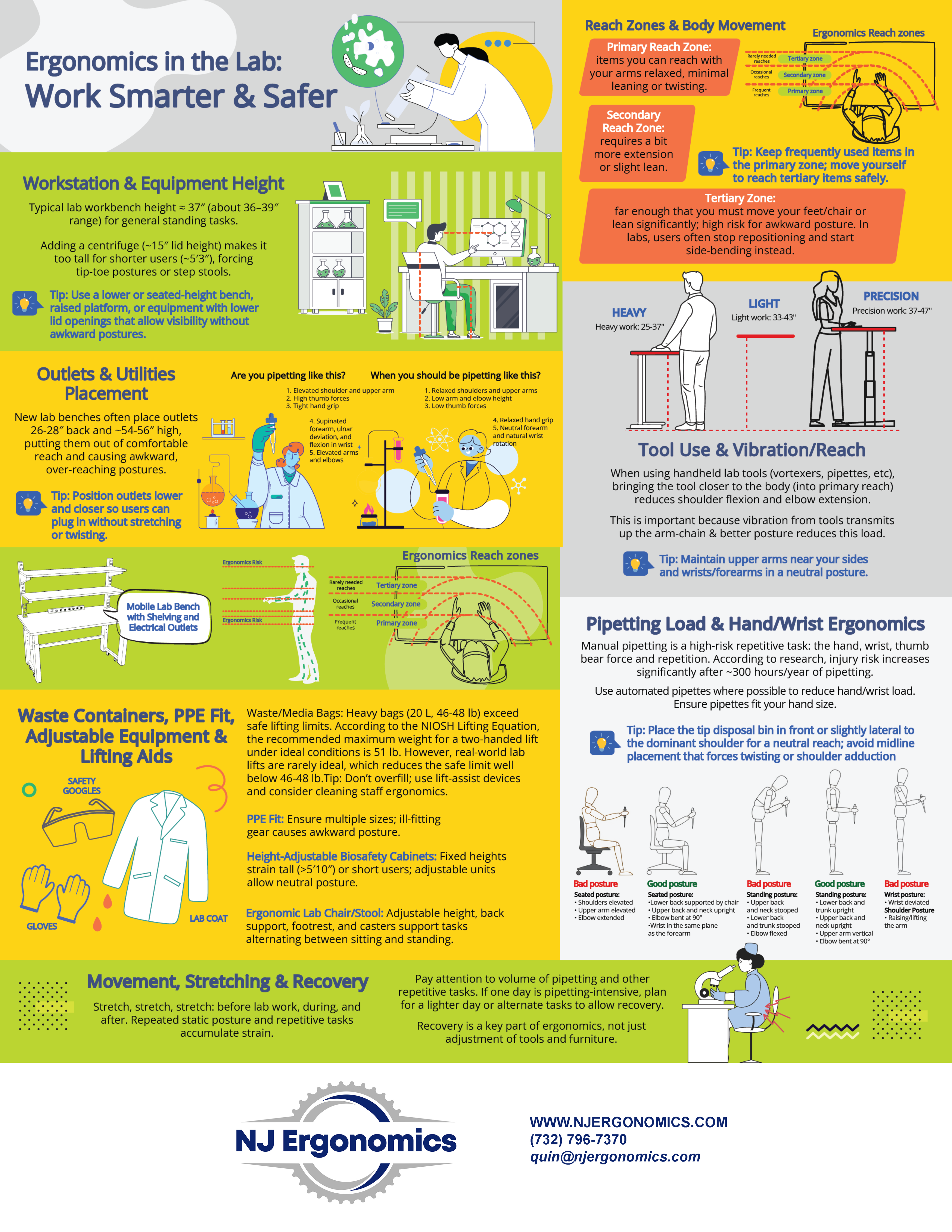
๐Ÿ”ฌ ๐—ฌ๐—ผ๐˜‚๐—ฟ ๐—›๐—ถ๐—ด๐—ต๐—น๐˜† ๐—ง๐—ฟ๐—ฎ๐—ถ๐—ป๐—ฒ๐—ฑ ๐—Ÿ๐—ฎ๐—ฏ ๐—ฆ๐˜๐—ฎ๐—ณ๐—ณ ๐——๐—ฒ๐˜€๐—ฒ๐—ฟ๐˜ƒ๐—ฒ ๐—ฎ ๐—ฃ๐—ฎ๐—ถ๐—ป-๐—™๐—ฟ๐—ฒ๐—ฒ ๐—ช๐—ผ๐—ฟ๐—ธ๐—ฝ๐—น๐—ฎ๐—ฐ๐—ฒ

Lab workโ€”whether in biosafety cabinets (BSCs), fume hoods or on the benchโ€”can demand long hours of intense precision work. This concentration often masks the physical strain that can lead to chronic musculoskeletal injuries (MSDs) in your most valuable assets.

Lab work doesn’t have to be painful.

The solution starts with meticulous ergonomic planning:

๐——๐—ฒ๐˜€๐—ถ๐—ด๐—ป & ๐—˜๐—พ๐˜‚๐—ถ๐—ฝ๐—บ๐—ฒ๐—ป๐˜: Implementing height-adjustable BSCs and ergonomic lab chairs allows you to tailor the core workspace to the user, not just generic standards.

๐—ง๐—ผ๐—ผ๐—น๐—ถ๐—ป๐—ด & ๐—ง๐—ฒ๐—ฐ๐—ต๐—ป๐—ถ๐—พ๐˜‚๐—ฒ: Selecting the right tools (e.g., automated pipettes, light-force tools) and ensuring proper reach zones significantly mitigates risk.

๐—ช๐—ผ๐—ฟ๐—ธ๐—น๐—ผ๐—ฎ๐—ฑ ๐— ๐—ฎ๐—ป๐—ฎ๐—ด๐—ฒ๐—บ๐—ฒ๐—ป๐˜: Lab managers must strategically schedule workloads. Too many consecutive hours of high-repetition tasks, like pipetting, puts technicians squarely in the danger zone for upper extremity overuse injuries.

๐—ฅ๐—ฒ๐—บ๐—ฒ๐—บ๐—ฏ๐—ฒ๐—ฟ: You must customize. While equipment is designed to accommodate the full range of body sizes (from 5th percentile females to 95th percentile males), the final setupโ€”chair height, BSC height, and primary reach zonesโ€”must be tailored to the individual associate. It’s no different than setting up an office workstation.
๐™‹๐™ง๐™ค๐™ฉ๐™š๐™˜๐™ฉ ๐™ฎ๐™ค๐™ช๐™ง ๐™ฉ๐™–๐™ก๐™š๐™ฃ๐™ฉ, ๐™ง๐™š๐™™๐™ช๐™˜๐™š ๐™ง๐™ž๐™จ๐™ , ๐™–๐™ฃ๐™™ ๐™ข๐™–๐™ญ๐™ž๐™ข๐™ž๐™ฏ๐™š ๐™ฅ๐™ง๐™š๐™˜๐™ž๐™จ๐™ž๐™ค๐™ฃ.

Reach out to us at 732-796-7370 or quin@njergonomics.com so we can discuss how to protect your lab staff.

Warehouses Aren’t One-Size-Fits-All: Why Tailored Ergonomics Matters

I recently had a conversation with a warehouse associate that truly highlighted a critical point: not all warehouses are created equal. He observed that new hires often bring habits from previous warehouse roles that simply aren’t suitable for their current environment. And he’s right!

Many people don’t realize the sheer diversity within the warehousing world. From public warehouses serving multiple businesses to private, company-specific facilities, and specialized distribution or e-commerce fulfillment centers focused on rapid turnover, each operates uniquely. Then there are cold storage units for perishables, climate-controlled spaces for sensitive goods, and even GMP-compliant warehouses with strict hygiene protocols, like those for pharmaceuticals or food.

While every warehouse involves material handling, the ergonomic needs and risks vary drastically based on the items, processes, and environment. For instance, a GMP warehouse might have unique handling requirements, like preventing wood pallets from entering sterile areas, which adds specific physical demands. The methods for storing, retrieving, and picking items also differ greatly based on item size and movement frequency.

Given this variability, a generic approach to ergonomics simply won’t cut it. To truly reduce musculoskeletal injuries in warehouses, we need:

  • Accurate Physical Demands Assessments: Objectively define the postural and physical demands of specific warehouse roles.
  • Tailored Manual Material Handling Programs: Customize training for new hires to address the unique needs of their specific warehouse.
  • Ergonomic Evaluations of Warehouse Spaces: Assess design and work processes to ensure they are ergonomically sound, recognizing that equipment suitable for one warehouse may be inappropriate for another.

Does your warehouse proactively tailor its ergonomic strategies to its unique demands? Let’s connect and discuss how a customized approach can protect your workforce and boost efficiency!

What Not To Do Wednesday – 3/22/17

Two recent stories have popped up in the last week that have to do with the wording of job descriptions and the impact of choice of words as well as the choice to use/not use the Oxford Comma.

In Maine, three truck drivers for Oakhurst Dairy sued their employer over the non-payment of overtime hours.ย  The case went to the 1st US Circuit Court of Appeals and hinged on a small detail – the Oxford Comma.ย  Maine law specifies specific tasks that are exempt from overtime pay:

The canning, processing, preserving, freezing, drying, marketing, storing, packing for shipment or distribution of:

(1) Agricultural produce;

(2) Meat and fish products; and

(3) Perishable foods.

The legal question hinges on whether “packing for shipment or distribution of” means “packing for shipment or distribution of” or “packing for shipment” and “distribution of” are two separate tasks.ย  The drivers were not a part of the packing for shipment (or packing for shipment and distribution) but were part of the distribution of the product.

Currently, the Court of Appeals has sided with the drivers that the statement means packing for “shipment and distribution” and not inclusive of the distribution of the packed product.ย  This missing comma has a potential value in the millions of dollars.

In a separate case, noted on John Geaney’s Workcomp Blog, he details the case of a pharmaceutical sales representative who developed vision problems that prevented her from being able to drive.ย  When the sales representative lost her ability to drive due to vision issues, she requested that Pfizer, her employer, provide her with a driver to drive her to sales appointments.ย  Pfizer declined this option and offered her a change in position to one which did not require driving to sales appointments.ย  The sales representative turned down that offer and filed an ADA case.ย  The case revolves around whether driving is an essential demand of the position.ย  Pfizer contends that driving to and from sales appointments is an essential demand while the sales representative contends that the ability to travel to and from sales appointments is the essential demand.ย  Unfortunately, the employer never listed the ability to drive or the requirement of a driver’s license as essential demands of the position. The appeals court has remanded the trial so that it can be determined whether driving is an essential demand for the position.

While this What To Do Wednesday post isn’t the typical, don’t be like the guy in this picture or story, it still presents important information of What Not To Do.ย  It can no longer be assumed that because a task is an essential demand due to longstanding tradition or an assumption of common sense dictates it to be.ย  Also, employers need to be aware of the potential grammar issues in job descriptions that may pose a problem when it comes to either payment for work performed or whether assigned tasks are included in the tasks covered by a specific law.