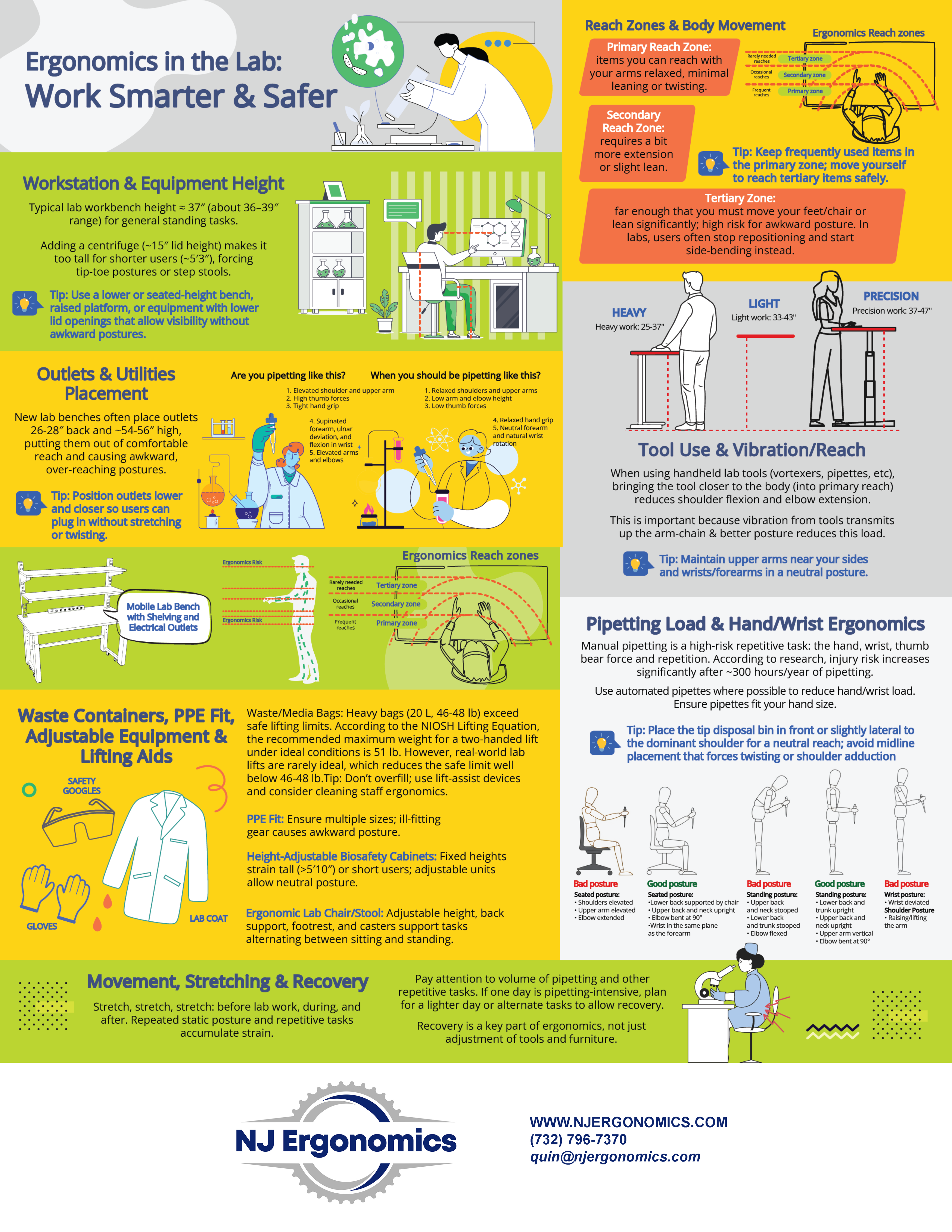
Lab work—whether in biosafety cabinets (BSCs), fume hoods or on the bench—can demand long hours of intense precision work. This concentration often masks the physical strain that can lead to chronic musculoskeletal injuries (MSDs) in your most valuable assets.
Lab work doesn’t have to be painful.
The solution starts with meticulous ergonomic planning:
𝗗𝗲𝘀𝗶𝗴𝗻 & 𝗘𝗾𝘂𝗶𝗽𝗺𝗲𝗻𝘁: Implementing height-adjustable BSCs and ergonomic lab chairs allows you to tailor the core workspace to the user, not just generic standards.
𝗧𝗼𝗼𝗹𝗶𝗻𝗴 & 𝗧𝗲𝗰𝗵𝗻𝗶𝗾𝘂𝗲: Selecting the right tools (e.g., automated pipettes, light-force tools) and ensuring proper reach zones significantly mitigates risk.
𝗪𝗼𝗿𝗸𝗹𝗼𝗮𝗱 𝗠𝗮𝗻𝗮𝗴𝗲𝗺𝗲𝗻𝘁: Lab managers must strategically schedule workloads. Too many consecutive hours of high-repetition tasks, like pipetting, puts technicians squarely in the danger zone for upper extremity overuse injuries.
𝗥𝗲𝗺𝗲𝗺𝗯𝗲𝗿: You must customize. While equipment is designed to accommodate the full range of body sizes (from 5th percentile females to 95th percentile males), the final setup—chair height, BSC height, and primary reach zones—must be tailored to the individual associate. It’s no different than setting up an office workstation. 𝙋𝙧𝙤𝙩𝙚𝙘𝙩 𝙮𝙤𝙪𝙧 𝙩𝙖𝙡𝙚𝙣𝙩, 𝙧𝙚𝙙𝙪𝙘𝙚 𝙧𝙞𝙨𝙠, 𝙖𝙣𝙙 𝙢𝙖𝙭𝙞𝙢𝙞𝙯𝙚 𝙥𝙧𝙚𝙘𝙞𝙨𝙞𝙤𝙣.
Reach out to us at 732-796-7370 or quin@njergonomics.com so we can discuss how to protect your lab staff.
The other day, I saw a contractor wearing a shirt that quipped about his fondest memories being when his back didn’t hurt. We shared a chuckle, but his follow-up comment hit home: “I wish it wasn’t true.”
This sentiment is far too common. I meet workers in nearly every industry who feel this way, and I always tell them: 𝗶𝘁 𝗱𝗼𝗲𝘀𝗻’𝘁 𝗵𝗮𝘃𝗲 𝘁𝗼 𝗯𝗲 𝘁𝗵𝗶𝘀 𝘄𝗮𝘆. My goal, and the core of my work with employers, is to ensure everyone goes home feeling as good as they did when they arrived. This isn’t just an EHS cliché for me; having spent years developing FCE testing protocols and witnessing the toll injuries take on livelihoods, it’s a deeply personal mission.
While we can’t eliminate every risk or reduce all physical demands to “light work,” we can absolutely prevent people from being physically beaten down by their jobs every day.
Here’s how we can make a difference:
𝗦𝗼𝗹𝗶𝗱 𝗣𝗵𝘆𝘀𝗶𝗰𝗮𝗹 𝗗𝗲𝗺𝗮𝗻𝗱𝘀 𝗔𝘀𝘀𝗲𝘀𝘀𝗺𝗲𝗻𝘁𝘀: Understand the true physical and postural demands of every role. 𝗣𝗼𝘀𝘁-𝗢𝗳𝗳𝗲𝗿 𝗣𝗿𝗲-𝗘𝗺𝗽𝗹𝗼𝘆𝗺𝗲𝗻𝘁 𝗧𝗲𝘀𝘁𝗶𝗻𝗴: Ensure new hires are a good physical fit for the essential demands of the job. 𝗘𝗿𝗴𝗼𝗻𝗼𝗺𝗶𝗰 𝗔𝘀𝘀𝗲𝘀𝘀𝗺𝗲𝗻𝘁𝘀: Identify and implement reasonable changes to high-demand, high-risk tasks. 𝗡𝗲𝗮𝗿 𝗠𝗶𝘀𝘀 & 𝗜𝗻𝗷𝘂𝗿𝘆 𝗜𝗻𝘃𝗲𝘀𝘁𝗶𝗴𝗮𝘁𝗶𝗼𝗻𝘀: Treat every incident as an opportunity to prevent future harm. 𝗥𝗲𝗴𝘂𝗹𝗮𝗿 𝗠𝗮𝘁𝗲𝗿𝗶𝗮𝗹 𝗛𝗮𝗻𝗱𝗹𝗶𝗻𝗴 𝗧𝗿𝗮𝗶𝗻𝗶𝗻𝗴: Equip employees with foundational knowledge and continuous refreshers to empower safer work practices.
There’s no good reason for workers to suffer. We have the tools and expertise to make a real difference.
What steps is your organization taking to ensure your team goes home feeling great at the end of every shift? Share your insights or reach out to discuss how we can help create a healthier, more productive workforce!
I recently had a conversation with a warehouse associate that truly highlighted a critical point: not all warehouses are created equal. He observed that new hires often bring habits from previous warehouse roles that simply aren’t suitable for their current environment. And he’s right!
Many people don’t realize the sheer diversity within the warehousing world. From public warehouses serving multiple businesses to private, company-specific facilities, and specialized distribution or e-commerce fulfillment centers focused on rapid turnover, each operates uniquely. Then there are cold storage units for perishables, climate-controlled spaces for sensitive goods, and even GMP-compliant warehouses with strict hygiene protocols, like those for pharmaceuticals or food.
While every warehouse involves material handling, the ergonomic needs and risks vary drastically based on the items, processes, and environment. For instance, a GMP warehouse might have unique handling requirements, like preventing wood pallets from entering sterile areas, which adds specific physical demands. The methods for storing, retrieving, and picking items also differ greatly based on item size and movement frequency.
Given this variability, a generic approach to ergonomics simply won’t cut it. To truly reduce musculoskeletal injuries in warehouses, we need:
Accurate Physical Demands Assessments: Objectively define the postural and physical demands of specific warehouse roles.
Tailored Manual Material Handling Programs: Customize training for new hires to address the unique needs of their specific warehouse.
Ergonomic Evaluations of Warehouse Spaces: Assess design and work processes to ensure they are ergonomically sound, recognizing that equipment suitable for one warehouse may be inappropriate for another.
Does your warehouse proactively tailor its ergonomic strategies to its unique demands? Let’s connect and discuss how a customized approach can protect your workforce and boost efficiency!
Did you know that working in cold environments can significantly affect your body’s strength, dexterity, and safety? 🧊 Cold temperatures cause muscles to stiffen, reducing grip strength and increasing the risk of hand fatigue. This can make even simple tasks more physically demanding, leading to a higher risk of injury.
Cold exposure also decreases blood flow to extremities, slowing reaction times and reducing tactile sensitivity. Muscles tighten up, limiting range of motion, increasing the risk of using less optimal postures to lift, push, and pull. Workers in industries like construction, outdoor maintenance, and agriculture are especially at risk.
💡 What can be done? ✔️ Provide thermal gloves that balance warmth and dexterity. ✔️ Schedule regular warm-up breaks to reduce stiffness. ✔️ Educate workers on early signs of cold stress and fatigue.
Protecting workers from extreme cold isn’t just about comfort—it’s essential for safety and long-term health. Let’s stay warm and stay safe!
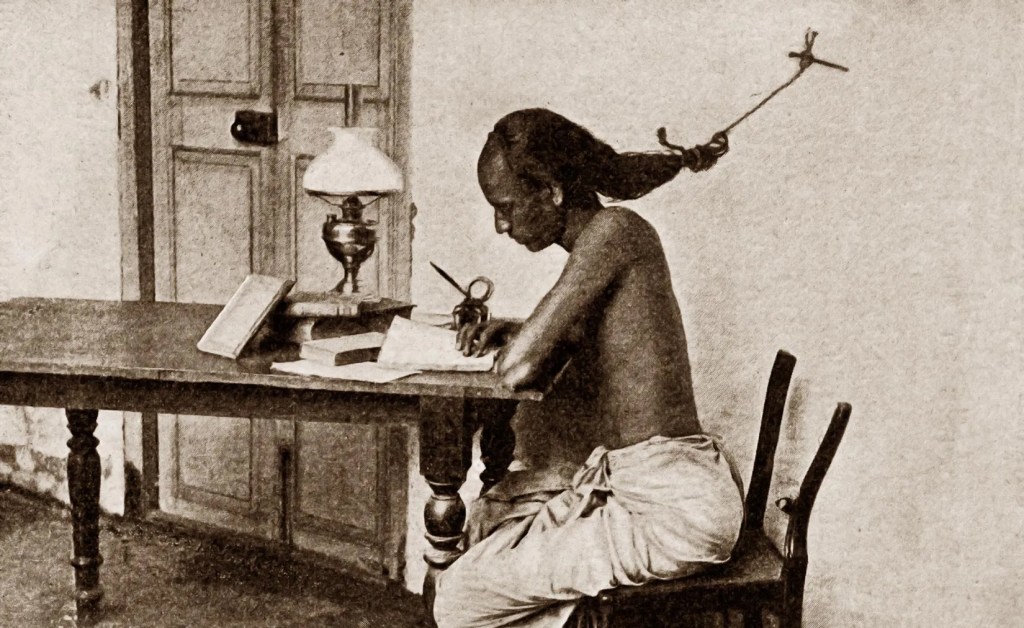
This photo entitled “How To Not Doze Off” is from the 1905 book “East and War” by Russian writer V.M. Doroshevich which described the Doroshevich’s travels to India. The subject of the photo is a student at Madras University.
Ergonomics has come a long way in the area of improving how we sit and perform tasks since the time of this photo.
We no longer need to nail strands of hair to the wall to keep us from falling asleep as we study – movement breaks can help.
We know that chairs with proper back support are better for us – so that we don’t fall into a forward leaning posture.
We know (much like our parents told us) to keep our elbows off the table – it causes us to shrug our shoulders.
We know that reading materials (or our computer screens) should be placed in a position relative to the height of our eyes (when we are in an optimal seating position) – so that we don’t flex our neck and shrug our shoulders while looking down.
For all of that knowledge, we know better. We know what to do to place our bodies in optimal positions to perform seated tasks in an efficient manner.
But, over the last couple of weeks I have heard the following from employees of different employers:
“They got rid of the adjustable chairs in the control room and replaced them with hard back non-adjustable chairs because they didn’t want us to fall asleep or get comfortable in the control room.”
“We need comfortable chairs to work in this room but the team in that room should not have comfortable seating. If they are comfortable, they won’t be as detail oriented as they need to be.”
Both of these comments come from positions that don’t understand that good ergonomics can keep workers comfortable while allowing them to pay better attention to the tasks that they are performing. These comments are counterproductive as they advocate for working postures and habits that place employees at risk for musculoskeletal injuries.
Providing appropriate seating for the task as well as education to employees on the best ways to set up their workstations – whether onsite or at home – can go a long way in improving employee performance and reducing the risks of musculoskeletal injuries. Lost time from those injuries can cause delays and increased costs that far outweigh the cost of optimizing their workstation.
Whether an office based work area, a workstation in a lab, or some type of industrial task, we can help you to identify potential ergonomic risks and help you to make the changes that will reduce musculoskeletal risks to your and your employees.
**Hat tip to writer and author Neal Bascomb who recently used this photo on a post for his excellent “Work/Craft/Life” blog. I would have never seen this photo if he hadn’t posted it.
Cuts and lacerations account for nearly 1/3 of all workplace injuries. But, a significant portion of all cuts and lacerations in the workplace are preventable by following some simple guidelines. It sounds simple and should be common sense but we’ve seen too many people over the years that lost significant work time due to easily preventable cuts and lacerations.
Before using a knife, make sure it is sharp and in good condition. A dull knife is more likely to slip and cause an accident. If the knife has any damage, do not use it.
Do not use a dull or blunt blade – harder to cut in a straight line with a dull blade and it can encourage the use of too much force.
Do not use too much force – greater chance for it to slip or go off target while at speed which can increase the severity of the laceration
Always cut away from your body and any other people nearby. This will help reduce the risk of accidental cuts or injuries.
Pay attention to what you are doing. Distractions can lead to accidents, so stay focused and avoid multitasking while using a knife.
Make sure the blade and handle are appropriate for the job – ergonomics are important.
Use cut resistant gloves – accidents do happen and cut resistant gloves can help to minimize the damage
Keep the right knife handy – keep the appropriate tool close to where it will be used so that people aren’t encouraged to use the nearest blade that they can find out of convenience
If you are not confident in your ability to safely use a knife, do not hesitate to ask for help or guidance from a more experienced colleague.
What is your company/organization doing for National Safety Month?
This is great opportunity to look at your work place to make changes that reduce the risk of injuries.
From ergonomic walkthroughs to material handling classes as well as job safety assessments and office/industrial ergonomics assessments, we can help you reduce risk of injuries for your employees.
This is a question that we have heard over the years from companies that require a Commercial Drivers License (CDL) for employees in certain job titles – whether they are bus/transport vehicle drivers or public works employees. For many positions that involve driving certain classes of vehicles, the state or federal government require a driver to have a CDL. One component of obtaining and maintaining a CDL is undergoing a DOT medical examination with a DOT certified provider.
The main purpose of a DOT medical examination as part of obtaining/maintaining a CDL is to ensure that a driver is medically safe to operate the vehicles within the classification of their license. Priority areas of a DOT medical exam include assessments of vision, hearing, blood pressure, cardiovascular health history, metabolic health history (ex. diabetes), and an overall physical assessment. An assessment of the upper and lower extremities checks for muscle weakness or loss of limbs. While range of motion is addressed in a DOT medical examination, it is to determine whether the examinee has any potential range of motion issues that the DOT examiner may feel are detrimental to their ability to operate trucks and passenger buses. While an employer may be sending a driver for an exam, the examiner is not evaluating based on specific job demands.
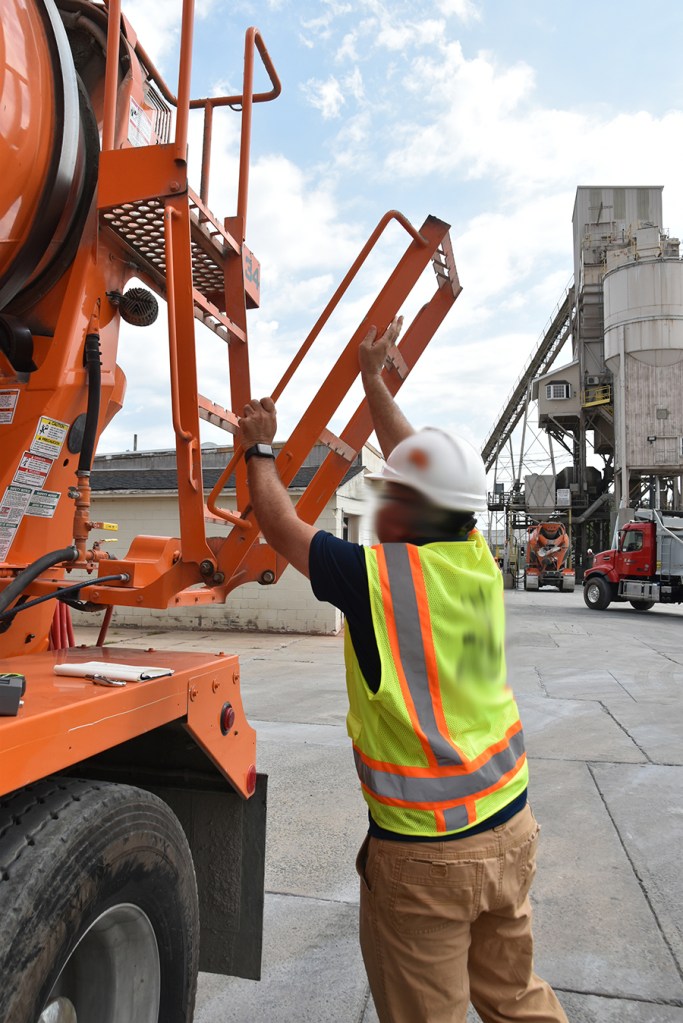
Concrete Mixer-Drivers have to be able to lower a ladder at the rear of the vehicle.
The DOT medical examination does not address specific range of motion issues related to ingress/egress for specific types of vehicles (how high is the first step and the grab handles), the range of motion required to operate controls on specific vehicles, or the strength and range of motion related requirements to perform employer specific tasks (loading/unloading products/materials, securing items, operating controls, moving hoses, pulling down ladders, etc.). A job specific post-offer physical pre-employment evaluation (or depending upon the situation, Return To Work FCE or Fit For Duty FCE) can address the examinee’s ability to perform the essential minimum postural and physical demands of the position. Employers should have a customized job description that includes objective measurements of the essential minimum physical and postural demands of the job title. These measurements should be collected using the vehicles, equipment, and other items that are used by the employer and employees when performing their job.
Obtaining a DOT medical certification does not necessarily mean that a driver can meet the essential postural and physical demands of a customized job description. Conversely, meeting the essential postural and physical demands of a customized job description does not mean that a driver will be able to successfully pass a DOT medical examination (a variety of medical conditions are automatic exclusions in DOT medical examinations or require physician approved waivers).
NJ Ergonomics can assist with the documentation of objective measurement of physical and postural demands of job tasks as well as generation of Post-Offer Pre-Employment physical abilities testing protocols that are based on the essential demands of a job title.
New Jersey employers will be facing two important changes to the Workers Compensation system in the New Year. These changes will bring additional costs for employers (while one improves benefits to the injured worker as well) and one change will potentially impact hiring processes for employers.
NJ Work Comp benefits to increase by 10%
As noted in John Geaney’s NJ Work Comp blog, work comp benefits in New Jersey will be increasing by 10% in 2022. This increase impacts weekly payments to employees who are out on workers comp as well as impacting the overall payments for permanent disability for a claimant and increasing the lawyers fees that are paid. One thing to remember is that the increase in payments for permanency awards still happens even if the injured employee even if there was no impact to their wages.
Employers can work to proactively reduce increased workers compensation costs by using customized job descriptions that are up to date, objective and accurately reflect the minimum essential physical and postural demands of the job title. These job descriptions can be used for post-offer pre-employment physical abilities testing, to help guide physicians and physical therapists in rehabilitating an injured employee safely and efficiently, to help identify appropriate modified duty tasks to help return the employee to the workforce as they recover, and to make accurate comparisons of physical abilities as they relate to essential job demands during a Functional Capacity Evaluation.
Gov. Murphy signs A2617 providing preference to employees who have reached MMI
The additional change to NJ Worker’s Compensation occurred in September of this year when Governor Phil Murphy signed A2617 which provides injured workers who have reached MMI hiring preference when they can no longer return to the position in which they were injured. The law does not fully define how the practice of providing preference to these employees will be implemented. The law applies to employers with 50 or more employees.
However, the one area that is defined within the law is that the injured employee must be able to meet the essential functions of the position for which they are applying.
“Following a work-related injury, an employer shall provide a hiring preference to an employee who has reached maximum medical improvement (MMI) and is unable to return to the position at which the employee was previously employed for any existing, unfilled position offered by the employer for which the employee can perform the essential functions of the position.”
This new law adds additional importance for an employer to have accurate, objective, and up to date job descriptions for each job title within their organization. Job descriptions should accurately define the minimum essential physical and postural demands related to the essential tasks performed within a job title. The descriptions should be kept up to date and take into account changes in policies, procedures, and even the items utilized to perform tasks – we have seen that shortages of supplies and mitigation procedures have altered how job tasks are performed. If these changes have become permanent in nature, the job description should reflect those changes and not reflect how the job was performed several years ago.
NJ Ergonomics can help employers to better define their job descriptions with accurate and objective measurements of essential job tasks as measured onsite for an employer. We can assist with helping employers put together defensible post-offer pre-employment testing programs to help identify whether job candidates meet the essential physical and postural demands of the position for which they are being hired.
This morning, I happened to see a web link that caught my eye in my Google news feed on my phone. When I opened the page, I saw a box just below the articles byline that contained the following:
This article was published more than 3 years ago. Some information may no longer be current.
This is something that we need to think about in terms of job descriptions as well. Many employers do not put a created or a revised date on their job descriptions. They really should. The created/revised stamp helps to remind those who use the description as to what may have been going on when the description was created or what events may have caused the revision of the job description. Without the note, it is difficult to tell when the description has been updated.
Why is it important to know when the job description has been created or revised?
A creation or revision date can help let treating medical professionals (doctors, physical therapists, nurse case managers, etc.) know whether they need to ask if there have been any changes to the job description that need to be taken into account when planning treatments to return an injured employee back to full duty. Accurate, up to date job descriptions also help with completing the return to work process when a Functional Capacity Evaluation (FCE) is performed. The dates help to make sure that the most up to date version has been sent to the FCE provider for comparison. Note: This happens more frequently than it should – an outdated version is sent to the FCE provider and then the updated copy is sent for a new comparison against the FCE performance of the injured employee.
Why should you update your job descriptions?
It is a good habit to review your job descriptions annually to determine whether there have been any changes to the particular description in terms of roles and responsibilities for the job title as well as whether there are any changes in the policies, procedures, and real world processes of how the job is performed.
Do all of the roles and responsibilities of the job description still apply?
Have any roles and responsibilities been added to the job title?
Have any roles and responsibilities been removed from the job title?
Are the job tasks still performed in the same manner?
Has the equipment that is used to perform the job been changed?
Has updating equipment made the task simpler?
Do equipment updates change a task from a 2 person task to a 1 person task?
Are supplies for a task shipped differently?
Do they come in a different type of container?
Do they come in a different weight or volume of product?
Have there been changes to PPE required to perform a task?
How has COVID changed task performance?
One of the questions that I now routinely ask is “How are things different in how you do your job since the pandemic?” I have heard a variety of answers in response to this question in terms of changes in tasking, task timing (more frequent cleanings of communal surfaces for custodial staff), and changes in task performance. Within public works departments, some bulk trash pickup teams now utilize heavy equipment to lift certain pieces of trash (furniture in particular) into the trucks. While this change started in the early days when there were many unknowns about how COVID was transmitted, it helped to reduce some of the significantly heavier physical demands on these employees.
For warehousing staff at large retailers, shipping difficulties have led to changes in both tasking and how tasks are performed. I’ve talked with warehouse staff that now perform other duties on days that shipments are not received and on the days that shipments come in, often work at a much quicker pace due to the influx of arriving merchandise on those days.
The pandemic has brought changes to how companies operate that should make them take a moment to review their job descriptions and see if the descriptions still match how the tasks are performed.
What do we do if something has changed?
Update the changes in your job description. Once you have updated the description, make sure that you have included a revision date either in the text of the document or in the footer.
If there have been significant changes to the description that potentially alter the physical and postural demands of the position (or if you haven’t previously documented these demands), we can help you to accurately and objectively document the physical and postural demands. As mentioned above, well documented demands can help physicians and physical therapists in their task of helping to rehab an injured worker so that they can safely return to work.



 NJ Ergonomics Blog